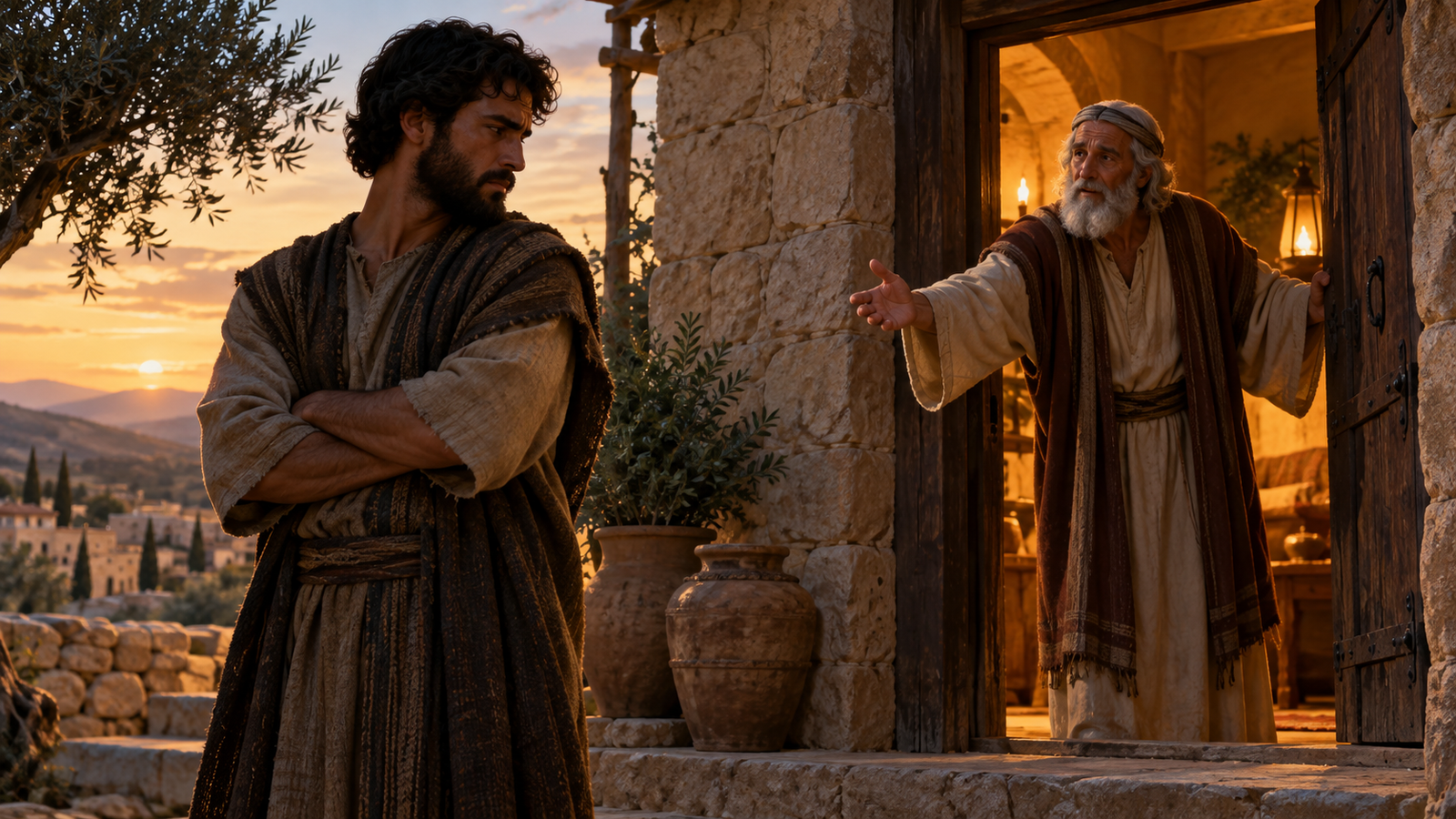
The Prodigal Son pt 2
Last week we read about the prodigal son. We learned that:
The younger son asked for his inheritance early and that was like wishing his father was dead. This was a huge sin in Jewish culture
He wasted all his money on partying. Another sin to not provide for the family.
Got so bad he worked with pigs, even envied their food. This is the lowest of the low in the Jewish culture. Many verses about how pigs are “unclean.”
His turning point, or “coming to his senses” was when he focused on the father.
Went back to the father and a long walk practiced his “story.”
His father saw him from a long way off and ran to him. Another faux pas in the Jewish culture.
Before the son can tell his story, the father cuts him off and forgives him and welcomes him back into the family. Showing that it is nothing that we can do, only God can save.
The father gave him 4 things, a robe, ring, sandals, and fattened calf.
Read Luke 15:25-32
The Older Son Complains.
25. “Meanwhile, the older son was in the field. When he came near the house, he heard music and dancing.
26. So he called one of the servants and asked him what was going on.
27. ‘Your brother has come,’ he replied, ‘and your father has killed the fattened calf because he has him back safe and sound.’
28. “The older brother became angry and refused to go in. So his father went out and pleaded with him.
29. But he answered his father, ‘Look! All these years I’ve been slaving for you and never disobeyed your orders. Yet you never gave me even a young goat so I could celebrate with my friends.
30. But when this son of yours who has squandered your property with prostitutes comes home, you kill the fattened calf for him!’
31. “ ‘My son,’ the father said, ‘you are always with me, and everything I have is yours.
32. But we had to celebrate and be glad, because this brother of yours was dead and is alive again; he was lost and is found.’ ”
1. “Meanwhile, the older son was in the field. When he came near the house, he heard music and dancing.
Working in the field – he was working even while the other son was gone. So he was a hard worker, which can be good.
Heard music. Put yourself here working in a field and you hear music
- What are you thinking? First curious? Is it for you?
2. So he called one of the servants and asked him what was going on.
He does not go himself, but calls a servant.
- (not biblical, just a thought) Does he think it is a surprise for him?
we know that he is self righteous, so may think it is for him.
3. ‘Your brother has come,’ he replied, ‘and your father has killed the fattened calf because he has him back safe and sound.’
Imagine what goes thru his mind now.
- For him?! Im working! They didn’t even come and get me?? I had to hear the music? Did they just forget about me???
- Ever felt like this? At home, at work, in a sport?
4. “The older brother became angry and refused to go in. So his father went out and pleaded with him.
What was the older brother’s sin? Consider how the cultural context magnifies his offense against the father.
During a banquet, the older son has a job of welcoming guests and running the staff. Not entering the house is a cultural insult.
- Also note: Older son mediator. Maybe he wanted him gone?
…So his father went out and pleaded with him.
Just like the younger son, “he ran to him..” This was a cultural faux pas that would anger the pharisees listening.
1. But he answered his father, ‘Look! All these years I’ve been slaving for you and never disobeyed your orders. Yet you never gave me even a young goat so I could celebrate with my friends.
- How does he address his father?
“Look!”
Compare that to verse 18, “father.”
Slaving – He is a hard worker, but not out of love. It is more out of obligation. his relationship to the father was more transactional.
Never disobeyed your orders –
- What is in the son’s heart to say this?
These exaggerations are common for those who hold on to bitterness. The older son finally showed this bitterness to the father, but only after it had done its damage in his heart over many years.
Couple of quotes –
ii. The older brother was unappreciative of all he did have. “Every day he had his father’s company, and the blessed society of home. His father’s love was round about him constantly, and everything the father had was his.” (Morrison) Yet, “The proud and the self-righteous always feel that they are not treated as well as they deserve.” (Morris)
iii. There was a sense in which the older son was obedient, yet far from his father’s heart. In this sense he was a perfect illustration of the religious leaders who were angry that Jesus received tax collectors and sinners. “His story reveals the possibility of living in the father’s house and failing to understand the father’s heart.” (Morgan)
1. But when this son of yours who has squandered your property with prostitutes comes home, you kill the fattened calf for him!’
…This son of your…
- What does the older brother mean by this?
Prostitutes? –
Is the older brother exaggerating? The verses above did not say prostitutes. He has not spoken with the younger brother. He has not left the field yet.
What does this show about the older sons heart while the younger son is gone.
Imagine him working in the field (probably for two…)
2. “ ‘My son,’ the father said, ‘you are always with me, and everything I have is yours.
Notice after the insults of the older son, the father calls him “My son”
everything I have is yours-
- Does this mean he is saved? Is this material? ??
3. But we had to celebrate and be glad, because this brother of yours was dead and is alive again; he was lost and is found.’ ”
- Was he actually dead? What does the father mean?
- What would make it difficult for the older son to accept the father’s grace?
He didn’t think he needed it.
- What sets the sons apart is their relationship to grace. The younger son repents and confesses his unworthiness to his father and in the end is restored as a son to his father’s household. But we do not see any sense of remorse or repentance by the elder brother. The parable simply ends with the father’s plea. This is in many ways the climax of the parable. It leaves us hanging, for we do not know how the son responds to his father’s entreaties. It is here that the parable confronts us most directly with our own decision. As one author describes, “Parables often lead the listener on a collision course with destiny. Each one who follows the path of the drama must make a decision. The listener is invited to step up onto the stage of the play and act out the final scene. In reality, the conflict could be resolved in two different ways. Everything depends on the final decision of the elder brother, i.e., the listener.”31 Will the Pharisees overcome their resentment toward those who do not “deserve” God’s mercy? Or will they cling to their self-righteousness and demand that love and grace be “earned”? From what we know in the rest of the Gospels, the Pharisees were not able to let go of their preconceived notions and humbly present themselves in brokenness before God. What will we do?
Barnewall, Michelle Lee. Surprised by the Parables: Growing in Grace through the Stories of Jesus (pp. 24-25). Lexham Press. Kindle Edition.
https://enduringword.com/bible-commentary/luke-15/
Translation notice: The historical source does not explicitly identify the Scripture translation. Quotations are preserved as supplied; NIV is used only as the default passage-link destination.
Image credit: AI-generated for BibleMens.