BibleMens Men’s Group | 10/14/2026
Opening question
Why do you like to collect things? In my case, it is cards, but it could be anything. What is it about collecting that is appealing?
Listen for these answers
- ☐ 1 — Nostalgia
- ☐ 2 — A favorite player, character, team, or universe
- ☐ 3 — The hunt
- ☐ 4 — The surprise of opening something
- ☐ 5 — Completing something
- ☐ 6 — The story behind the object
- ☐ 7 — Artwork and appearance
- ☐ 8 — Owning a piece of the real thing
- ☐ 9 — Making fandom physical
- ☐ 10 — Self-expression and identity
- ☐ 11 — Community and belonging
- ☐ 12 — Family connection
- ☐ 13 — Legacy
- ☐ 14 — Buying what you could not have as a child
- ☐ 15 — Scarcity and rarity
- ☐ 16 — Discovery and learning
- ☐ 17 — Organizing
- ☐ 18 — Revisiting something you love
- ☐ 19 — Escape and relaxation
- ☐ 20 — Making new memories
- ☐ 21 — Potential financial upside
- ☐ 22 — Trading and negotiating
- ☐ 23 — The feel of physical objects
- ☐ 24 — Owning a manageable piece of something enormous
Introduction
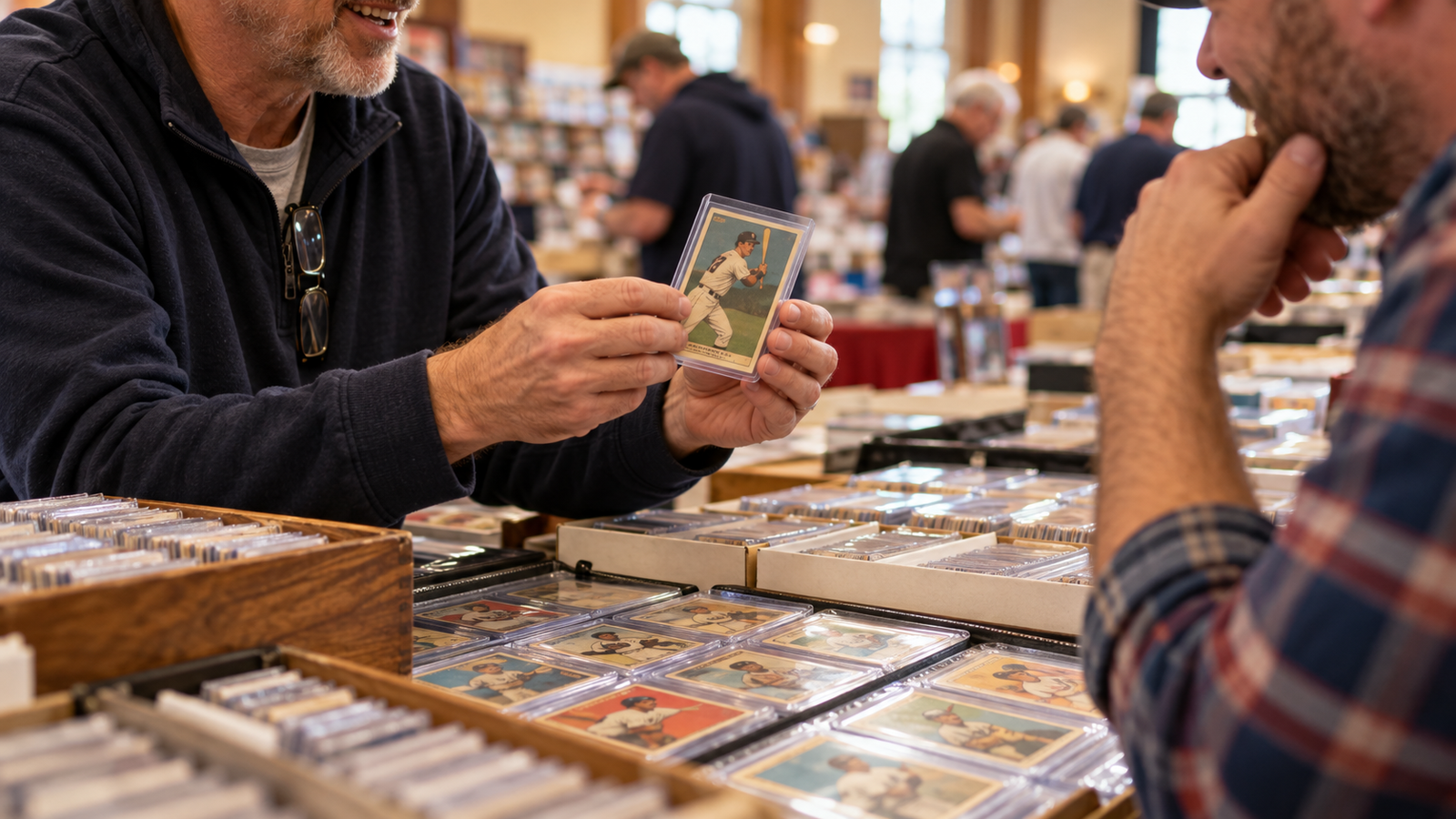
Recently I was sitting behind my table at a trading card show and having some great conversations with people. Most of the people there shared a love for collecting cards. Some were looking for a favorite player. Some were trying to complete a set. Some enjoyed the artwork, the history, the hunt, or simply talking with other collectors. A few seemed to be there mainly to make a quick profit.
That got me thinking about why people collect. Obviously, the Bible does not mention baseball cards, Star Wars figures, or numbered parallels. But the reasons people are drawn to them are not new. Underneath collecting are things such as memory, beauty, curiosity, belonging, family, order, rest, accomplishment, and the desire to hold onto something meaningful. Those are human desires the Bible does address.
The goal of this study is not to make every card spiritual. It is to listen carefully to the reasons people give for collecting and then ask: What biblical principle is underneath that reason?
What draws us in
1. Nostalgia — getting a piece of childhood back
This may be the most common reason people collect. They are not necessarily buying cardboard or plastic; they are buying a feeling they remember. A Star Wars collector may buy the same Power of the Force figures he had as a child because seeing them brings back the excitement of going to the store with his parents. Baseball collectors often return to the players and cards they remember from childhood.
Psalm 143:5
“I remember the days of old. I meditate on all your doings. I contemplate the work of your hands.”
Biblical principle — remembrance can reconnect us with what shaped us. Scripture treats memory as powerful. Looking back can stir gratitude, help us recognize what mattered, and remind us of what God has done.
- What does something in your collection bring back to you, and why does that memory still matter?
2. Connecting with a favorite player, character, team, or universe
A Vikings card, Ken Griffey Jr. card, Darth Vader figure, or Luke Skywalker card becomes a physical representation of something the person already cares about. One Star Wars collector said the figures give him a tangible version of characters that otherwise exist only on a screen.
Philippians 4:8
“Finally, brothers, whatever things are true, whatever things are honorable, whatever things are just, whatever things are pure, whatever things are lovely, whatever things are of good report: if there is any virtue and if there is anything worthy of praise, think about these things.”
Biblical principle — we are drawn to people and stories that represent qualities we admire. Paul told believers to direct their thoughts toward what is true, honorable, just, pure, lovely, and worthy of praise. A favorite player, character, team, or universe often becomes meaningful because it represents courage, excellence, loyalty, perseverance, or a story we find compelling.
- What quality, story, or value does your favorite player, team, character, or universe represent to you?
3. The hunt
Sometimes finding the item is more fun than owning it. Searching card-shop bargain boxes, shows, online listings, trades, flea markets, and old collections becomes an activity of its own. One football-card collector described missing the old experience of spending hours flipping through card-store boxes and unexpectedly finding something forgotten or interesting.
Proverbs 2:4–5
“if you seek her as silver, and search for her as for hidden treasures; then you will understand the fear of the LORD, and find the knowledge of God.”
Biblical principle — diligent searching has value when the thing being sought is worth finding. Collectors understand patience, attention, and the willingness to keep looking. Scripture uses that same picture to describe the serious pursuit of wisdom.
- Is the enjoyment mainly in owning the item, or in the patience, knowledge, and effort required to find it?
4. The surprise of opening something
A sealed pack contains uncertainty: What am I going to get? Collectors repeatedly mention the excitement of opening packs without knowing what is inside. Box breaks intensify that experience by adding a live audience, limited products, and the possibility of a valuable hit.
Proverbs 25:25
“Like cold water to a thirsty soul, so is good news from a far country.”
Biblical principle — unexpected good news refreshes us. Part of the appeal is the sudden arrival of something good that we did not know was coming. Surprise can produce a real burst of delight.
- How can we enjoy surprise without becoming dependent on bigger risks or bigger hits to feel the same excitement?
Completion stories and beauty
5. The satisfaction of completing something
Set building turns collecting into a clearly defined mission: 347 out of 350, then 348, then 349, and finally 350. Vintage collectors sometimes spend years completing sets. One collector reported working on several 1950s Topps sets and reaching 98 or 99 percent; the last few cards became a challenge of their own.
Genesis 2:2–3
“On the seventh day God finished his work which he had done; and he rested on the seventh day from all his work which he had done. God blessed the seventh day, and made it holy, because he rested in it from all his work of creation which he had done.”
Biblical principle — purposeful work has a proper completion and a proper rest. Finishing something can be satisfying because human beings were made to do meaningful work, recognize when it is complete, and then rest.
- Why is the final card so satisfying, and are you able to enjoy completion before immediately beginning another chase?
6. The object tells a story
Vintage sports cards can function like miniature pieces of sports history. Collectors talk about owning cards that show players and moments that tell the story of the game. A 1950s baseball card is not merely an old collectible; it gives someone a physical connection to an era he never experienced.
Joshua 4:6–7
“that this may be a sign among you, that when your children ask in the future, saying, ‘What do you mean by these stones?’ then you shall tell them, ‘Because the waters of the Jordan were cut off before the ark of the LORD’s covenant. When it crossed over the Jordan, the waters of the Jordan were cut off. These stones shall be for a memorial to the children of Israel forever.’”
Biblical principle — physical objects can preserve a story and invite the next generation to ask about it. The object is not the event itself, but it can keep the event from being forgotten.
- Which item in your collection tells the best story, and who needs to hear that story from you?
7. Aesthetics — sometimes it simply looks awesome
Artwork, photography, refractors, foil, designs, patches, and card layouts matter independently of monetary value. One football-card collector said one of his favorite cards was not worth much; he simply loved the way it looked. Star Wars Galaxy collectors often point to the artwork as the main reason they collect the line.
Genesis 2:9
“Out of the ground the LORD God made every tree to grow that is pleasant to the sight, and good for food, including the tree of life in the middle of the garden and the tree of the knowledge of good and evil.”
Biblical principle — beauty is not the same thing as usefulness. God made things that were good for use and also pleasant to look at. Human beings were created with the ability to recognize and enjoy beauty.
- What card or object do you enjoy simply because it is beautiful, even if it has little market value?
Physical connection identity and belonging
8. Owning a tiny piece of the real thing
Autographs, game-used patches, pieces of bats, jerseys, and other memorabilia change an object from a picture of someone into something physically connected to that person. Star Wars collectors similarly value actor autographs and original sketch cards. Part of the appeal is the thought: This person actually touched or signed this.
John 20:27
“Then he said to Thomas, ‘Reach here your finger, and see my hands. Reach here your hand, and put it into my side. Don’t be unbelieving, but believing.’”
Biblical principle — physical contact can make a claim or connection feel immediate and real. John 20 is not about memorabilia; it records the physical reality of Jesus’ resurrection. Thomas was invited to confront evidence he could see and touch.
- Why does knowing that a player or actor actually touched an item change how the item feels to you?
9. Fandom becomes physical
Watching the Vikings, Yankees, or Star Wars is temporary. A collection remains on a wall, desk, shelf, or in a display case. One Star Wars collector said inexpensive one- or two-dollar cards and a sketch card displayed in his office brought him more enjoyment than expensive sports-card collecting had.
Deuteronomy 6:8–9
“You shall bind them for a sign on your hand, and they shall be for frontlets between your eyes. You shall write them on the door posts of your house and on your gates.”
Biblical principle — visible reminders keep important things in front of us. The comparison has limits: a card is not Scripture. Still, God understands that physical reminders can repeatedly direct human attention toward what they represent.
- What does the way you display your collection keep in front of your mind?
10. Self-expression and identity
Collections say something about the collector: “I’m a Cubs guy.” “I’m a Jordan guy.” “I love vintage baseball.” “I’m the Boba Fett guy.” The things people choose to display become a visible representation of their interests and, in a smaller way, how they see themselves.
Galatians 2:20
“I have been crucified with Christ, and it is no longer I who live, but Christ lives in me. That life which I now live in the flesh, I live by faith in the Son of God, who loved me and gave himself up for me.”
Biblical principle — everyone builds an identity around something, but a Christian’s deepest identity is found in Christ. A collection may express part of us, but it cannot define the whole person.
- If someone knew only what you collect, what would he understand about you—and what important parts of your identity would he miss?
11. Community and belonging
Trading naturally creates interaction. Shows, shops, online groups, and trading forums give people a reason to talk to strangers who already share an interest. One baseball-card collector said the hobby was largely social for him: buying, selling, and trading mattered, but he especially enjoyed talking with people and making deals.
Romans 12:4–5
“For even as we have many members in one body, and all the members don’t have the same function, so we, who are many, are one body in Christ, and individually members of one another.”
Biblical principle — people were not made to live as isolated individuals. Shared interests can create a doorway into community, while Christian fellowship goes further by making believers responsible for one another.
- When has collecting helped you move from being a stranger to feeling that you belonged?
Family legacy and value
12. Family connection
This comes up constantly: collecting with Dad, remembering collecting with Dad, introducing a son or daughter to cards, or planning to pass a collection down. One collector said he collects partly because he hopes to share the hobby with his son when he grows older. Vintage collectors often remember hunting for cards with their fathers decades ago.
The movie Field of Dreams captures this through Ray’s complicated relationship with his father. Baseball ran through both their closeness and their conflict. Early in the film Ray says, “Dad was a Yankees fan then, so of course I rooted for Brooklyn.” After years of distance and regret, their reunion comes through the simple question, “You wanna have a catch?” Baseball did not erase what had gone wrong between them, but it gave a father and son a shared language and a way back toward one another.
Malachi 4:6
“He will turn the hearts of the fathers to the children and the hearts of the children to their fathers, lest I come and strike the earth with a curse.”
Biblical principle — shared activity can help turn the hearts of generations toward one another. The greatest value is not the object being collected but the relationship strengthened through time, attention, and shared experience.
- What family relationship has been strengthened by collecting or another shared interest?
13. Legacy — this will be theirs someday
A collection can feel different from ordinary possessions because people imagine handing it down. The story attached to Dad’s favorite player card may eventually matter more than the card’s market value. That is one reason an inexpensive collection can carry enormous personal value.
Proverbs 13:22
“A good man leaves an inheritance to his children’s children, but the wealth of the sinner is stored for the righteous.”
Biblical principle — a good person thinks beyond his own lifetime. Material possessions may be part of an inheritance, but the wisdom, faith, generosity, stories, and character passed down are even more important.
- If your collection is passed down, what story or values do you hope will travel with it?
14. Wish fulfillment — buying what you could not have as a child
Adults finally have money. A child who could not afford an expensive card, complete set, Millennium Falcon, or premium action figure may be able to buy it thirty years later. Many collectors describe the pleasure of finally acquiring something they wanted as children but never received.
Ecclesiastes 3:13
“Also that every man should eat and drink, and enjoy good in all his labor, is the gift of God.”
Biblical principle — the ability to enjoy the results of our work can be received as a gift from God. Enjoyment is not automatically selfish. It becomes healthier when it is joined with gratitude, wisdom, and contentment.
- When does buying something you once wanted feel like grateful enjoyment, and when can it become an attempt to fill something possessions cannot repair?
15. Scarcity makes possession feel special
Numbered cards, rare parallels, short prints, old surviving cards, autographs, and limited figures introduce the idea that not everybody can have this. Rarity transforms an ordinary object into a challenge and an accomplishment. The limited supply becomes part of the attraction.
Matthew 13:45–46
“Again, the Kingdom of Heaven is like a man who is a merchant seeking fine pearls, who having found one pearl of great price, he went and sold all that he had and bought it.”
Biblical principle — people are drawn to what they recognize as unusually valuable. Jesus used the picture of a merchant who could identify one exceptional pearl. The parable is about the surpassing worth of God’s kingdom, not about collectibles, but it shows the power of recognizing value.
- Does rarity make you appreciate an item more, or does it mainly make you want what other people cannot have?
Learning order and rest
16. Discovery and learning
Cards introduce people to players, seasons, statistics, teams, artists, printing methods, and history they otherwise would not know. Vintage collectors often describe learning baseball history through the players on their cards. One item can open the door to an entire time period or subject.
Proverbs 18:15
“The heart of the discerning gets knowledge. The ear of the wise seeks knowledge.”
Biblical principle — a discerning person wants to gain knowledge and keeps listening for more. Curiosity can be a good gift when it leads to understanding rather than merely collecting facts.
- What is something important you learned only because a card or collectible made you curious?
17. Organizing is satisfying
Sorting by year, set, player, team, number, condition, or character creates a manageable little world that can be put in order. Set builders talk about checklists, tracking progress, binders, storage, and finally seeing everything organized and displayed together.
1 Corinthians 14:40
“Let all things be done decently and in order.”
Biblical principle — order can serve clarity and make something useful. In its original setting, this verse concerns orderly worship in the church. The wider principle is that structure should reduce confusion and help things serve their purpose.
- What part of sorting and organizing feels satisfying to you: control, clarity, progress, or simply seeing everything where it belongs?
18. An excuse to revisit something you love
Sorting baseball cards means thinking about baseball. Rearranging Star Wars figures means thinking about Star Wars. Searching for a Walter Payton rookie may lead to reading about Walter Payton. The collectible repeatedly pulls the owner back toward the interest underneath it.
Psalm 119:97
“How I love your law! It is my meditation all day.”
Biblical principle — what we love naturally returns to our thoughts. Repeated attention is not random; it reveals affection. Our minds revisit what our hearts have learned to value.
- What subject does your collection repeatedly draw you back toward, and what does that show about your affection?
19. It provides an escape
Looking through cards, visiting a show, reorganizing a collection, or hunting online can occupy the mind for a while without demanding very much. That break can be refreshing during a stressful season. It can also become avoidance if it keeps a person from facing responsibilities, relationships, or problems that need attention.
Mark 6:31
“He said to them, ‘Come away into a deserted place, and rest awhile.’ For there were many coming and going, and they had no leisure so much as to eat.”
Biblical principle — rest is a legitimate human need, but healthy rest restores us. Jesus recognized that tired people sometimes need to step away from constant demands.
- Does collecting usually refresh you so you can return to life, or does it sometimes help you avoid life?
Memories motives and money
20. The collection creates memories of its own
Eventually a card is not merely “a 1989 Griffey.” It becomes the card Dad gave me, the one I found at the National, the one I pulled with my son, or the card I searched five years to find. The story of acquiring an object can become more meaningful than the object itself.
1 Samuel 7:12
“Then Samuel took a stone and set it between Mizpah and Shen, and called its name Ebenezer, saying, ‘The LORD helped us until now.’”
Biblical principle — an ordinary object can become a marker of a meaningful moment. Samuel’s stone did not create God’s help; it gave the people a physical reminder of the help they had already received.
- Which item matters most because of the memory of how, where, or with whom you acquired it?
21. Potential financial upside
Some collectors enjoy believing their collection may increase in value. Many make a sharp distinction between collecting, investing, and flipping, while others combine all three. The possibility of profit adds another layer of excitement, but it can also change how a person relates to the hobby.
Proverbs 21:5
“The plans of the diligent surely lead to profit; and everyone who is hasty surely rushes to poverty.”
Biblical principle — careful planning and patience are different from hurried attempts to get rich. Financial gain is not automatically wrong, but haste, hype, and the fear of missing out can quickly overpower wisdom.
- If the value never increased, would you still be glad you owned the collection?
22. Trading itself can be the hobby
Negotiating a deal, deciding what to give up, upgrading a collection, and finding someone who needs what you have creates an entire game layered on top of collecting. For some people, the process of making the trade is as important as the cards.
Proverbs 11:1
“A false balance is an abomination to the LORD, but accurate weights are his delight.”
Biblical principle — God cares about honesty and fairness in ordinary transactions. A trade is not good merely because both people agreed to it; our words, descriptions, measurements, and use of superior knowledge still matter.
- What does a fair trade require when one person knows much more about the items than the other?
Physical pleasure and connection
23. Tactile pleasure — physical things still matter
Holding, flipping, sorting, sleeving, displaying, and rearranging physical collectibles is different from looking at an image on a phone. Star Wars collectors talk about the tactile quality and fine details of figures and ships. Part of the pleasure is simply handling something real.
1 Timothy 4:4–5
“For every creature of God is good, and nothing is to be rejected if it is received with thanksgiving. For it is sanctified through the word of God and prayer.”
Biblical principle — physical creation can be received as good when it is enjoyed with thanksgiving. Christianity does not teach that physical things are automatically inferior or unspiritual. The question is how they are received and used.
- What is lost when a physical collection becomes only a digital image or number on a screen?
24. A manageable way of owning part of something enormous
You cannot own the NFL, the Yankees, Michael Jordan’s career, or the Star Wars universe. But you can own a group of objects representing it. Collecting reduces a huge interest into physical pieces that can be held, studied, organized, and displayed.
Psalm 8:3–4
“When I consider your heavens, the work of your fingers, the moon and the stars, which you have ordained, what is man, that you think of him? What is the son of man, that you care for him?”
Biblical principle — a small point of focus can lead the mind toward something far larger than itself. David looked at the moon and stars and was drawn into wonder about creation, humanity, and God.
- How does one small object open the door to a much larger story, world, or history for you?
A warning about excess
When collecting begins to control us
Collecting can become compulsive. Some collectors openly describe packs, breaks, rapid bidding, and uncertain rewards as feeding the same urge as gambling. The combination of speed, social pressure, scarcity, and the possibility of a major hit can become financially destructive. The chase can be good entertainment, but it has a darker extreme.
1 Corinthians 6:12
“‘All things are lawful for me,’ but not all things are expedient. ‘All things are lawful for me,’ but I will not be brought under the power of anything.”
Biblical principle — something may be permissible and still gain unhealthy power over us. Christian freedom does not mean surrendering control to an appetite, habit, marketplace, or repeated rush.
- What warning signs would show that collecting is no longer something you enjoy but something that has begun to control you?
Collecting as a gift from God
When we put all twenty-four positive reasons together, many of them reflect good things God has placed in human life: memory, curiosity, beauty, creativity, order, rest, family, friendship, learning, storytelling, and the pleasure of physical creation. Collecting can give those desires a harmless and enjoyable place to operate. In that sense, the ability to enjoy collecting can be received as one of God’s ordinary gifts.
James 1:17
“Every good gift and every perfect gift is from above, coming down from the Father of lights, with whom can be no variation nor turning shadow.”
But a gift is healthiest when it remains connected to the Giver. The same hobby can become distorted by greed, envy, pride, dishonesty, impulsiveness, escapism, or compulsion. The test is not whether collecting is spiritual enough. The test is whether we can receive it with gratitude, practice it with self-control, and keep it in its proper place.
Pointing it back to Jesus
Collecting can point us toward Jesus when it helps us recognize deeper truths:
- Nostalgia can remind us of God’s faithfulness through the years.
- The hunt can remind us that truth and wisdom are worth seeking.
- Scarcity can remind us that Christ and his kingdom are the treasure of greatest value.
- Completion can remind us that Jesus finished the work of salvation we could not finish ourselves.
- Community can remind us that we were made to belong to the body of Christ.
- Family and legacy can remind us to pass on faith, not merely possessions.
- Beauty can direct our gratitude toward the Creator.
- Rest can remind us that Christ welcomes the weary.
- Physical objects can remind us that Jesus entered the physical world, died, and rose bodily.
- The danger of compulsion can remind us that freedom is found in being ruled by Christ rather than by our appetites.
Colossians 3:17
“Whatever you do, in word or in deed, do all in the name of the Lord Jesus, giving thanks to God the Father through him.”
1 Corinthians 10:31
“Whether therefore you eat or drink, or whatever you do, do all to the glory of God.”
The purpose is not to force Jesus into a hobby where he does not belong. It is to recognize that if Jesus is Lord of our lives, then he is also Lord of how we spend our time, use our money, treat other people, enjoy good gifts, and respond when a good thing begins to take too much of our heart.
- Which reason for collecting most clearly feels like a gift from God in your life?
- Which reason is most likely to become distorted or take too much control?
- What is one way your collecting could become more grateful, generous, honest, relational, or Christ-centered?
Main idea
Collecting is appealing because it gathers many God-given human desires into one activity: remembering, searching, learning, creating order, appreciating beauty, setting goals, sharing life with others, and holding onto meaningful stories. Those desires can be enjoyed with gratitude. They can also be twisted by pride, greed, escape, or compulsion. A Christian collector does not have to pretend the cards are more spiritual than they are. He can simply enjoy them as a gift, keep them in their proper place, and let the way he collects reflect the character of Jesus.
Sources and translation notice
Scripture quotations are from the World English Bible Updated, a public-domain translation. Translation labels are omitted from the individual verse headings for cleaner reading.
The twenty-four positive collecting motivations, the warning about excess, and the real-world examples were supplied by the study leader from earlier collector research and conversations. Biblical passages were selected for the underlying principle in each motivation; none of the passages is presented as being originally about trading cards.
- World English Bible Updated: eBible.org
- Featured photo by Mick Haupt on Unsplash.